
This animation was made in collaboration with Fundación Loros (loros.org). Animation and page by Alejandro Rigatuso, Fundación Loros (2026), based on Chris Biro’s free-flight training method.
It shows the first steps of free-flight training for parrots being prepared for release: training in the aviary, then opening the aviary doors, and finally working outside. Every phase repeats the same cycle: signal, wait, mark, reward. Use the language buttons at the top of the animation to switch between English and Spanish.
Important: this is release training, not pet training
The process in this animation was designed for parrots being prepared for release into the wild, based on the training used in the Colombia release. Release birds are trained this way on purpose: the goal is a bird that is not comfortable being social with people. Contact is kept to the minimum needed to deliver food, and the birds learn to fly between perches and to outdoor feeding stations rather than to a person.
Pet birds are trained differently, because the goal is the opposite: a bird that stays social, with its flight behaviors built around interaction with its trainer. Two perches are used only to get a pet bird started. Training then moves to flights back and forth between a perch and a person. Pet birds are not flown in and out of an aviary or building like this; outdoor flying starts over short distances and rebuilds, outdoors, the behaviors the bird has already learned indoors. Baby birds trained at the optimum age do not need this process at all, and adult birds that are reluctant to use their wings need a modified version that differs in important ways.
The underlying concepts are the same, but every training program is tailored to the goals for that particular bird. This animation is only a teaching aid. It is not a replacement for full training and hands-on instruction. Applying it should be supervised by veterinarians, biologists and experienced keepers, and adapted to each bird and each rehabilitation center.
Want to free-fly your own bird? Do not try to copy this animation. The differences between release training and pet training are exactly why proper instruction matters. Learn the approach that fits your bird through Chris Biro’s free-flight training programs before you start.

The framework behind this training: Configuration: The Fifth Question of Ethology adds a fifth question to Tinbergen’s four: what is the current configuration of this individual’s five behavioral components – body, personality, beliefs, emotions and instincts? Preparing parrots for release is a question of configuration. The training shown on this page, used in the Brazil and Colombia release projects, is how captive-raised birds were configured to live as wild birds, and the book explains the framework behind it.
What comes after the first steps
The animation shows how training begins. To see where it leads, look at the skill progression from our 2022 Brazil release. Six young blue-and-yellow macaws were scored twice a week on every skill, from perching and short hops to navigation, flock flying, full days at liberty and finally feeding themselves. Wild feeding comes last by design, once the birds are already close to adult capability.
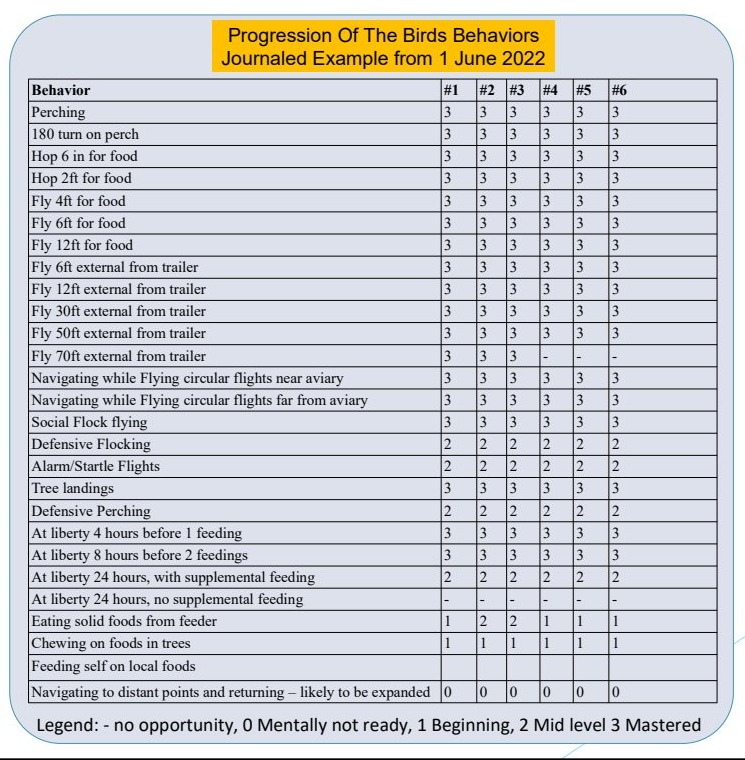
Skill progression table from the Brazil release poster, journaled example from 1 June 2022. Click to open the full poster.
See the Brazil release poster and skill progression →
See the method in practice
In these two videos Chris Biro trains blue-and-yellow macaws with the V-perch approach shown in the animation, during the 2023 Bird Recovery International release project in Colombia.
More video of the Amazon parrots being trained and flown in Colombia:
Partway through, the UnBehavior book trailer shows footage of the Brazil release birds flying.
The full story of the Brazil release: a mini documentary of the project.
For additional information about the behavior theory used in this process, we recommend reading the Applied Evolutionary Ethology series of books and papers. Fundación Loros also publishes this animation on its own site, in Spanish and other languages: Entrenamiento de vuelo libre (loros.org). For more on their release work, visit loros.org.